When You’re in the Messy Middle: How Jessica Golden Helps Women Move Through Change, Grief, and Becoming
Interview by Heather Anderson
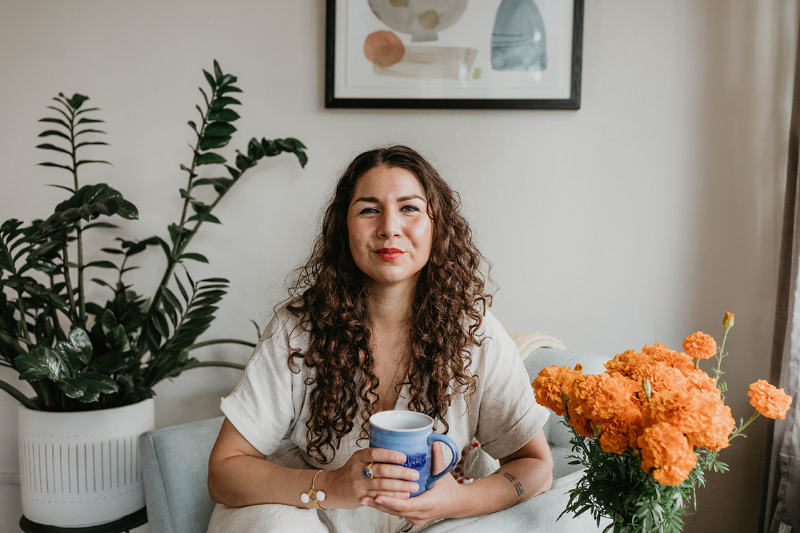
Jessica Golden has spent years walking people through the parts of life no one prepares you for — pregnancy, loss, identity shifts, illness, heartbreak, even the “my kids are older and I don’t know who I am now” moment. She’s an acupuncturist, herbalist, clinical hypnotherapist, and embodiment coach, and her work centers around rites of passage — the moments where who you’ve been is dissolving and who you’re becoming hasn’t quite arrived yet.
Her practice, Kin Medicine, is built around a simple idea: you don’t have to white-knuckle your way through change alone or pretend you’re fine. You get to be guided, held, and witnessed as you cross into the next version of yourself.
In this conversation, we talk about how to know you’re in a rite of passage (even if it just feels like “I’m not okay”), how the body signals what it needs, what actually happens in a session with her, and why she believes ritual and community are medicine.
Can you take us back to the moment you knew this wasn’t just a career path, but the work you were here to do?
When I first started out, I was a journalist, volunteering on the weekends at Memorial Sloan Kettering in New York, helping cancer patients write their stories — not “what happened to me” stories, but “who am I now” stories. I was watching people meet the absolute edge of themselves and somehow become more of themselves in the process. I would sit with someone and feel chills the entire time.
That feeling — witnessing someone step through the deepest part of their life and come out more rooted in who they are — that imprinted on me.
Over time I realized: this is what I’m called to hold. Those moments when life drops you into the deep water, where you’re not who you were but you’re not yet who you’re becoming. A lot of people call it the dark night of the soul. I love thinking of it as “the crossing.” You’re in between identities, in between versions of self, and what you really need is someone holding a lantern, walking with you, saying: keep going, this part matters.
That’s the thread that’s run through everything I’ve done — working in nutrition and behavior change at Whole Foods Market, working with cancer patients at Charlotte Maxwell Clinic, supporting pregnant moms at the Homeless Prenatal Clinic in San Francisco, becoming a mother myself. I’m drawn to that middle place where everything feels disorienting and sacred at the same time.

You work at that edge of change, but you also work in the body. You call yourself an intuitive acupuncturist and embodiment coach. Not every practitioner blends acupuncture, herbs, hypnotherapy, energy work, and coaching the way you do. How did that integrated approach evolve?
It honestly evolved because acupuncture alone was helping… but not quite answering people’s “why?”
People would get relief — less pain, better sleep, calmer nervous system — but they still wanted meaning. They still asked, “What is this tension really about? What is my body trying to tell me?”
I started weaving in hypnotherapy so we could access that deeper layer: the subconscious patterns, the stories, the unprocessed experiences that live in the body. And as I did that work — and as I went through my own rites of passage — my intuitive work opened up. My ability to track not just, “Your neck is tight,” but “This tension feels like something you’ve been carrying since before you even had language for it.”
So now I don’t separate Western lens vs. Eastern lens vs. energy. We use all of it with reverence. I want the person in front of me to actually feel like a participant in their own healing, not just a body on a table being “fixed.”
When you bring acupuncture, somatic work, guided inner work, and energetic support together, something important happens: the person starts to remember themselves. It’s not “make me normal again.” It’s “help me become who I actually am now.”
“Your womb is a creative center. It’s where life is held, yes, but it’s also the energetic center of “I know.” It’s where we feel our deep yes and deep no.”
For someone who’s never done this kind of work: what does it actually feel like to work with you? Can you walk us through what a mom might experience over time?
Most of my work now happens in a six-month container. I’ve learned that’s the amount of time you need to really descend into the depth of what’s happening — the grief, the unraveling, the “I don’t recognize myself” — and then come back through the other side with clarity and steadiness.
Here’s how it works in real life:
We meet for one 90-minute session in person each month (I’m in Berkeley and Pleasanton), and then we meet twice virtually between those visits.
That in-person session is part conversation, part bodywork, part nervous system repair, part soul work.
We’ll start by talking. I’ll ask what’s coming up for you right now. Where are you feeling stretched? What feels tender? Where are you craving support? I’ll also ask where it’s landing in your body — not just “how’s your mood,” but “what’s happening in your chest, in your pelvis, in your sleep, in your appetite.”
Then you get on the table.
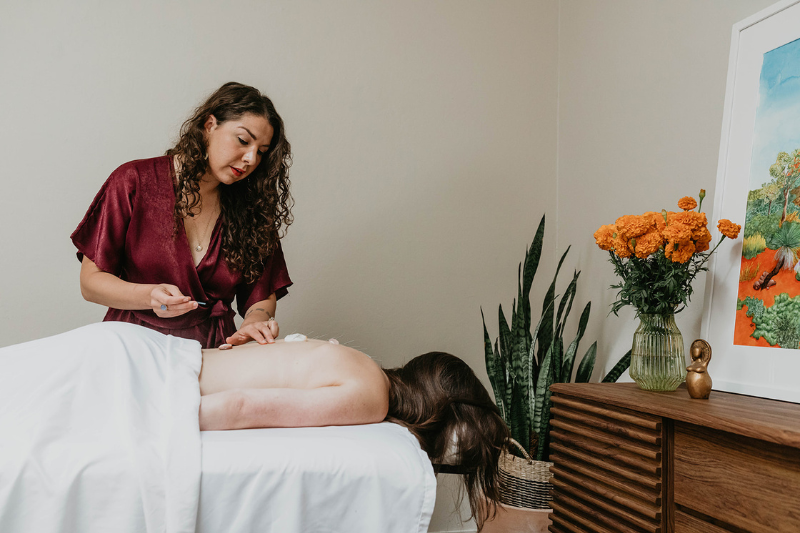
I might use acupuncture. I might do abdominal massage (so much is held in the belly, and we almost never let anyone touch it because it feels so vulnerable). I might do craniosacral work, cupping, pelvic steaming, or gentle energy work. Sometimes I’ll place a point and feel, intuitively the whole body responds with, “This one matters for you today,” and the whole session shifts around that.
While you’re on the table, I’m tracking your body and also guiding you. I might walk you through a visualization that brings you to a really safe internal place. We might meet what’s living underneath the surface — grief that never got named, fear, anger, longing. Sometimes there are ancestral pieces that come forward: a long held pattern that’s ready to shift, a grandmother’s presence, a sense of being supported from beyond. Sometimes the body releases and you can literally feel a pattern of holding let go.
As you speak things out loud, your energy changes in real time. I’m tracking this through the pulses, a diagnostic method we use in Eastern medicine and through the body’s energy. You can feel something unlock in your throat and simultaneously soften in your pelvic floor. You can feel where you’ve been tight or numb for years suddenly feel warm and available again.
And under all of that is the question we’re always holding together: what are you actually longing for in this next version of you? Not “How do I go back?” but “What would feel nourishing and true now?”
For moms specifically, a huge theme is depletion. “I am fried. I love my people, but I am running on fumes.” The work we do is about rebuilding that center — helping you move from chronically overextended and empty-cup to resourced, steady, present, and actually able to enjoy the life you built.
This is where the coaching comes in. Between the in-person deep dives I help you integrate the changes and hold the new patterns, especially when you start to wobble. I prescribe specific herbs, foods, rituals and movement or relational practices that bring the changes into your everyday life. It’s not a massage. It’s not talk therapy. It’s not a quick acupuncture appointment. It’s all of those layers woven together in service of you remembering yourself.

Right after you described that, you said something so beautiful: that a lot of this lives in the womb. Can we pause there? What do you mean when you say our womb space is part of our intuitive power?
So many women are completely disconnected from their womb, pelvis, and menstrual cycle — not because they’re “out of touch,” but because most of us were taught to shut that area down. There’s shame around it. There’s trauma stored there. There’s numbness. There’s “I don’t even want to think about that part of me unless I’m trying to get pregnant or I’m in pain.”
In my work, especially with moms and with people trying to conceive, I started seeing how much lived there.
In Chinese medicine, the womb and pelvis are where we carry stagnation and unprocessed experience. Painful periods, cysts, fibroids — yes, we can talk about them physiologically (and we should), but they’re also often places where something hasn’t been allowed to move.
When we start tending that space — through acupuncture, abdominal work, pelvic steaming, herbs, guided inner work — it’s not just about fertility or hormones. It wakes something up.
Your womb is a creative center. It’s where life is held, yes, but it’s also the energetic center of “I know.” It’s where we feel our deep yes and deep no. It’s where we access a kind of feminine power that is not “push through and dominate,” but “root in, soften, receive support, stand in quiet authority.”
I watch people reconnect to that part of themselves and it changes how they mother, how they partner, how they lead. It’s not about becoming “the old me again.” It’s about stepping into a version of you that is resourced from the inside out.
That’s honestly the core of my work — helping women wake that back up, so they can lead their actual lives from it. I actually think this is the type of leadership the world so desperately needs.
You talk a lot about rites of passage — pregnancy, heartbreak, illness, perimenopause, even identity shifts like ‘my last kid just left for college.’ A lot of us don’t even realize we’re in one until we’re already falling apart. How can a mom tell she’s in that kind of moment, and what’s the first thing she can do to ground herself?
In a lot of cultures, you would never go through a rite of passage alone. There are elders. There are rituals. There’s someone saying, “This is what’s happening. You are crossing. Here’s how we hold you through it.”
We don’t really do that here. So most of us only realize we’re in one because nothing “works” anymore.
The way you’ve always managed stress suddenly doesn’t touch it.
Your relationships feel different and you can’t fake it the old way.
Your sleep is off, your digestion is weird, you’re more reactive, you feel like you’re “too much” or “not enough” at the same time.
You catch yourself thinking, “Who even am I right now?”
That’s a rite of passage.
Becoming a mother is a classic one. You technically have nine months to “prepare,” but still — the identity break that happens when the baby is actually here? It’s a lightning strike. You cannot fully imagine that version of yourself ahead of time.
The first step in those moments is not “fix it.” It’s not “figure out who you are now” in one night. It’s: come back to your center.
And I get that “center” can sound abstract, so here’s what I mean: picture a storm. Total chaos at the edges. But there’s always an eye. There is always a still point. You still exist in there, even if you don’t recognize yourself yet.
Practically, that looks like pausing instead of chasing answers. Literally breathing into your body. Letting yourself land in the moment instead of mentally sprinting to solve “the rest of your life.” When you do that, something shifts: you move from “I’m lost and I’m failing” into “I’m in a becoming.” You stop treating it like you’re broken and start treating it like an initiation you’re crossing through.
That tiny reframe changes how you walk through it.
Let’s talk about the fog. So many moms describe the postpartum era, or divorce, or even empty nest, as “I feel like I’m in a fog and I can’t get myself back.” How do you support someone in that space between who they were and who they’re becoming?
First, I normalize it. The fog is not proof something’s wrong. The fog is part of the crossing.
You’re like a boat in mist. You can’t see the shore you left anymore, but you also can’t make out the new shoreline yet. Every instinct says, “Turn around. Go back to what you know.” But you can’t actually go back — that version of you doesn’t exist anymore.
In those moments, having someone beside you saying, “Keep going, the other side is real and if you can let go and trust through the fog, life is gonna get so much better” is everything.
This is also a spiritually thin time. Postpartum is the obvious example — your nervous system is wired to be hyper-attuned so you can care for a baby. Your intuition is loud. You’re porous. You’re in between worlds. A lot of my clients start feeling support that isn’t just physical. Grandmothers. Ancestors. Guidance they can’t fully explain. That’s real, and I treat that as part of care.
We also work with surrender — which is different from collapse. It’s the practice of letting yourself be supported by something bigger than just your willpower. That’s uncomfortable for a lot of us because we’ve been taught to survive by pushing, not by softening. But softening is often where the actual healing happens.
You’ve said the body is basically giving us messages all day long, but most of us only listen when it starts screaming. What are some of those early messages? What should we be paying attention to?
Your body almost always whispers before it yells.
The whispers look like: tight belly, tight jaw, tight hips. Waking up at weird hours. Ringing in your ears. Heart racing or headaches that show up the second you sit down. Feeling heavy and dense in your body for “no reason.” Appetite going way up or way down.
Most of us live with that all the time and call it normal.
What I teach is: don’t wait for the meltdown version. Start decoding your patterns now. “Oh, this knot in my throat always shows up when I’m holding back what I actually need.” “This pulling in my pelvis always shows up when I’m pushing through and abandoning myself.” When you can read the subtle cues early and trace them back to the root, you can support yourself early — before you’re in crisis.
It’s not about “never feel stressed again.” It’s about being in relationship with your body instead of dragging it behind you.
You use the phrase ‘nourishment inside and out’ a lot. You even named your work Kin. What does that look like in real life, not just as a pretty idea?
In Chinese medicine there’s a whole philosophy called “nourishing life.” It’s not “wait until you’re sick and then seek help.” It’s “How are you feeding your life force every day?”
For me (and for my clients), that means living in rhythm instead of in constant override.
It means honoring the actual season you’re in, instead of pretending you’re supposed to have the same energy 12 months a year, 24 hours a day. It means honoring where you are hormonally and cyclically. It means letting your actual body — not the cultural checklist — set the pace, the food, the boundaries, the way you rest, the way you create.
It’s not about perfection. It’s about relationship. “What nourishes me, specifically — body and soul — and what quietly drains me?” And then having the courage to unsubscribe from what doesn’t actually serve you.
That’s what I want for women: a life where your body feels like your home, not your project.
You’re developing something new that I’m obsessed with — ritual kits for rites of passage. Tell us about those.
One of the things I see again and again is that women are having these enormous life moments — miscarriage, first period, menopause, heartbreak, marriage, postpartum — and no one is marking it with them.
We’re not meant to move through that alone. We’re supposed to be witnessed, honored, held.
So I’ve been creating Rites of Passage ritual kits: small, intentional boxes built around a specific transition.
Each kit is different, but they include things like:
An herbal tincture formulated for that exact passage (for example: courage, releasing grief, calling in steadiness)
Ritual tools and sensory anchors to help you name and honor what’s happening in your body
Gentle guidance for how to actually hold a personal ritual — not in a performative way, but in a “this is mine, this matters” way
There’s a kit for pregnancy loss. There’s one for heartbreak. There’s one for marriage. There’s one for first bleed. There’s one for menopause. There’s one for postpartum.
They’re for you, if you’re moving through something and you want to feel held. And they’re also for the friend you love but don’t know how to show up for. Instead of “let me know if you need anything,” it’s “I see the magnitude of what you’re living, and I honor you.”
To me, those kits are about giving people a physical, beautiful way to say: this wasn’t ‘just a thing that happened.’ This changed me.
Your work isn’t about “bounce back.” It’s about emergence. When someone finishes work with you, what do you most want them to know and feel?
I want them to feel how profoundly supported they actually are.
Yes, supported by people — friends, community, strangers who somehow say the exact right thing in the grocery line. But also supported by the earth, by their ancestors, by whatever they believe is bigger than them. There is so much love and guidance around us, all the time.
That’s why I named the practice Kin. You are in relationship with everything. You’re not doing life as an island. You’re woven into a fabric of support.
And when you let yourself lean into that — instead of “I have to fix this all by myself” — the whole process of becoming the next version of you feels less like a crisis and more like a claiming.

Work with Jessica one-on-one in her six-month container, blending intuitive acupuncture, hypnotherapy, embodiment coaching, and hands-on bodywork to move you from depletion back into deep, grounded resource.
Visit one of Jessica’s clinics in Berkeley or Pleasanton for acupuncture or hypnotherapy.
Explore Jessica’s Rites of Passage ritual kits (pregnancy loss, heartbreak, first bleed, postpartum, menopause, marriage) and learn how to honor the exact moment you’re in. Kin Medicine Ritual Kits These are coming – ideally the first one is being launched next month.
Learn more about nourishing your life “inside and out,” and what it means to move through a rite of passage instead of just surviving it.
Subscribe to her weekly Love Notes newsletter
or Follow her on Instagram
You can also find Jessica Golden on The M List The Mamahood’s searchable database of mom-recommended resources, or connect and collaborate with Jessica inside The Club membership for women Founders.