Forest Time, Big Feelings, and Muddy Boots: Inside Oak Heart Forest Program with Andrea Hector
Interview by Heather Anderson
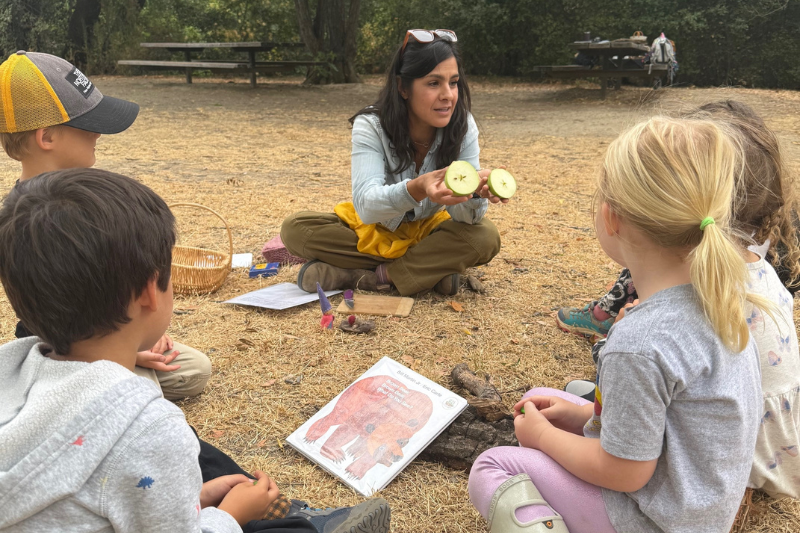
Families in the East Bay are finding something rare in the woods: room to breathe. At Oak Heart Forest Program, founder and educator Andrea Hector blends nature exploration with social–emotional learning so kids can move their bodies, work through big feelings, and rediscover curiosity—without a worksheet in sight.
Andrea’s path to fully outdoor teaching began during a school closure and solidified through the pandemic, when time outside became both refuge and classroom. Today, her mixed-age program invites children (and often their grown-ups) to slow down, notice the natural world, and build confidence—one tree climb, puddle splash, and birdsong at a time.
Let’s start at the beginning. When did you know nature wasn’t just healing for you—but something you wanted to share with kids and families?
It honestly started by accident. I was teaching in a mixed-age Waldorf kindergarten that emphasized time in nature, with a weekly hike day. Unfortunately after seven years, the school shut down and it was a shock for teachers, parents, and their children. A family had access to a local Girl Scout camp, so we gathered there and I began developing a full forest kindergarten—outside 100% of the time, in every season.
Being outdoors became deeply healing during that transition—for me as a teacher and as a mom—because my two oldest were part of that school community, too. Later I taught at a forest school in Oakland, and then COVID hit. Suddenly I was home with three kids and no job. Out of that experience came Oak Heart Forest Program. Looking back, each big life disruption pushed me back into the woods. Nature was the steady place where I could process, create, and build something new—so that’s where I stayed.
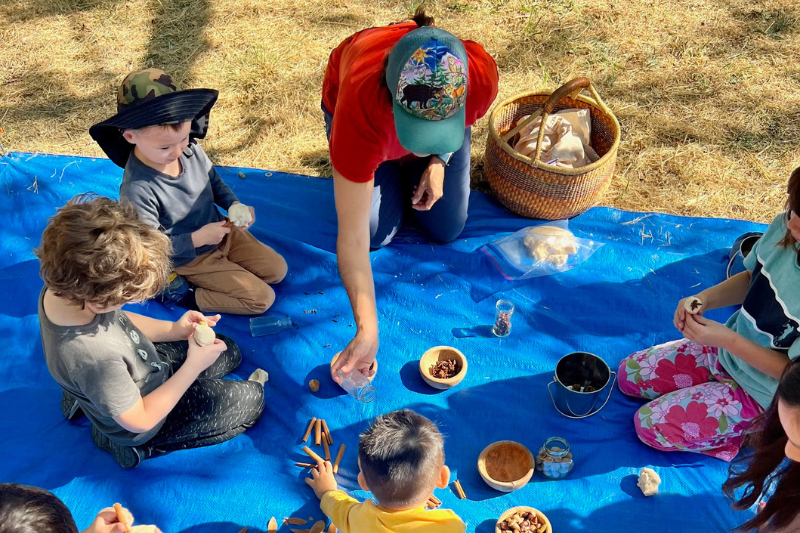
Not every outdoor program pairs nature play with intentional social–emotional learning. Why did you build Oak Heart this way?
Years before this, while teaching in Oakland and Berkeley classrooms, I could see children arriving with needs we weren’t fully equipped to meet. I learned from working with various early childhood specialists and OT’s and built my educator “toolbox,” but the biggest shifts showed up when we were outside. The natural environment regulates nervous systems. It gives children space to move, negotiate, and reset.
When my co-founder and I shaped Oak Heart, we wanted the foundation to be place-based, inquiry-driven, and play-based—with social and emotional learning woven through everything. It’s for every child, but especially powerful for neurodivergent learners or children who haven’t felt fully supported in traditional settings.
“Small, consistent touches with the natural world spark curiosity—and often lead to bigger adventures later.”
From your vantage point, what are the biggest struggles kids face today—especially kids of busy parents—and how does time in the forest help in ways a classroom can’t?
We’re all overscheduled. Families juggle activities back-to-back, and unstructured outdoor time falls off the calendar. Children need time to just be—to feel the sun or the wind, to work out friendship bumps, to process big feelings without a bell ringing every 20 minutes. Classrooms rarely allow for that kind of pace or don’t always have the right resources to meet the needs of the children in the way they truly need to be met.
Outdoors, things slow down. Community is created. There’s time to connect with peers, with adults, and with the place itself. I see children soften, regulate, and open up when the environment isn’t telling them to hurry.
Parents tell me, “I wish my kid would unplug and actually connect.” What does that look like at Oak Heart—practically?
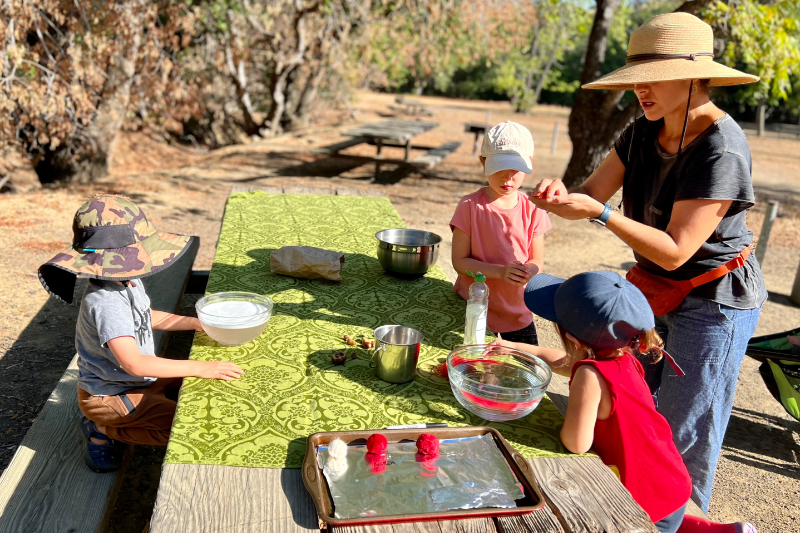
We root our days in the seasons and the land. This Fall, we took a deep dive into Elderberry. The children learned to identify it, smell it, (when appropriate) taste it, and then use it. We made Elderberry soap and syrup, and even did smash-art with the berries.
We go on hikes, forage for plants we can learn from, climb trees, and track along trails. We follow curiosity: once the children found a huge egg on a hillside, which turned into a whole day of observation and questions. Lately there’s been a fascination with birds craze, so we’re integrating bird study into play and stories.
Some offerings are crafted by teachers; others are completely organic and lead by the children. A bucket plus rain plus mud becomes a full-body sensory lab. From there, connection multiplies—children collaborate, share discoveries, and care about one another because they’re doing together, not just talking about it.
How do kids connect with one another? Any favorite games?
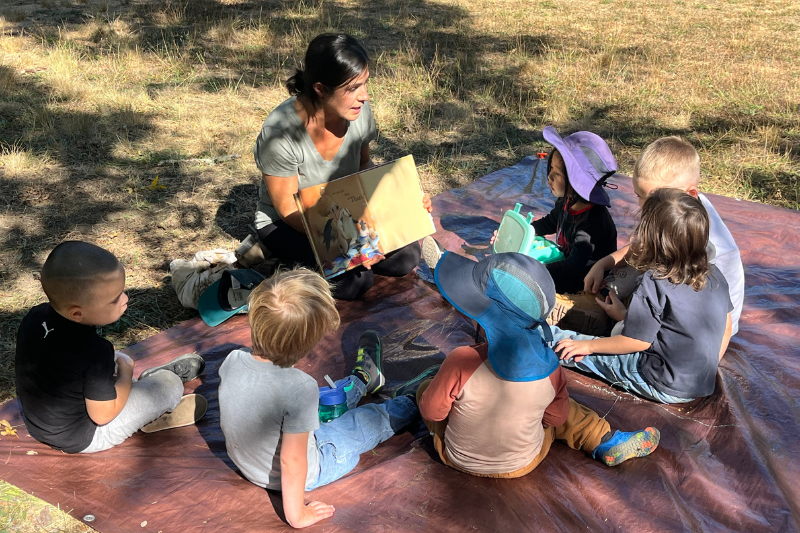
We start with a morning circle—seasonal songs, movement, and playful games—plus daily yoga (sometimes child-led). “Sleeping Giant” is a hit: one child is a friendly forest giant “asleep” by a tree; others take turns as helpful fairies trying to return the giant’s scattered treasures without waking them. There’s teamwork, opportunities to practice mindfulness, and lots of giggles.
“Mr. Fox” introduces the predator–prey dynamic through chase-and-freeze play. Our “Bluebird” circle game turns children into trees with raised “branches” while a bird weaves through. Mixed ages matter: older children often lead the play now, inviting little ones in, adapting rules, and modeling care. That peer leadership is beautiful to watch.
You talk about kids feeling safe in nature and confident in themselves. What sparks that shift?
A big piece is risky play—the healthy kind. Tree climbing is the classic example. Many caregivers arrive uneasy about it, which is understandable. I always remind them: you’re your child’s best teacher. I’m here to guide, but you know your child.
Over time, we see a double shift: caregivers grow more confident observing what their children can do, and children build real competence. One child last year barely touched the lowest branch and mostly observed. This year she’s climbing much higher—carefully, proudly, with strong body awareness. That transition from observer to capable is about more than trees. It shows up in communication, in asking for help, in trying again after frustration. The forest gives safe space for those muscles to grow.
Some parents worry about safety, weather, or their child not “fitting in.” How do you ease those concerns?
We invite families to experience Oak Heart together first. Our Forest Play Group is a gentle “try-it” option where caregivers stay and participate. It lets adults feel the environment, see the flow, and ask questions. Those conversations build trust.
We also hop on calls before enrollment if parents want to talk through specifics—especially for children with unique support needs. The aim is a safe, caring, positive outdoor space for the whole family. Starting alongside your child is often what settles the nervous system—for both of you.
Who tends to enroll at Oak Heart? Can you talk about ages, and the kinds of kids and families who usually feel like, “Oh, this is for us”?
Forest Play Group: ages 2–8, with a caregiver; siblings welcome.
Drop-Off Forest Program: ages 3–6, mixed-age (which we love—there’s so much peer modeling and leadership).
Families who find us often have children who crave movement and hands-on, full-body exploration—mud, rain, dirt, tree-climbing, puddle-splashing. We also see many neurodivergent learners whose parents are seeking a setting that meets sensory and social needs more naturally. And we welcome families brand-new to outdoor life who want a safe group format to begin.
Sometimes the child is the connector (“my best friend is there!”). Other times, it’s the grown-up who wants more nature time with their child—they might even volunteer with us. All are welcome.
Do you have a favorite “blossomed in the forest” story?
One six-year-old comes to mind. Her application listed multiple diagnoses, lots of appointments, and significant needs. We scheduled a phone call with her mom, then welcomed her with a specialist who shadowed briefly to teach us specific supports.
Outdoors, she thrived. She’s always been social and active, but over a year or two we watched huge growth—emotionally, verbally, in self-advocacy with teachers and peers. Now one of our older kids, she tells us what she needs, helps others, and radiates pride. Her mom has noticed it too. Watching that progression—supported by community and the natural world—is why I do this work.
For parents who want more grounding in nature at home—no forest required—what’s one simple practice to start now?
Keep it easy and close. Step outside your front door and notice trees, clouds, wind. Walk to a local park and collect a few leaves to explore at home. Bring the outside in: plant seeds on a sunny windowsill, keep a seasonal nature basket, watch sprouts together. Small, consistent touches with the natural world spark curiosity—and often lead to bigger adventures later.
How is Oak Heart different from a typical after-school class—and what do you wish more parents understood about nature-based learning?
After-school programs usually offer a short, product-oriented block: start the project, finish the project, go home. At Oak Heart we’re process-focused and immersive. Because we’re rooted in a specific place, children build real relationships with the land—plants, animals, weather, terrain—and with one another.
We believe direct, nourishing sensory experiences create strong, loving connections to the natural world. When children care about a place—because they’ve climbed its trees, listened for its birds, and watched its berries ripen—they carry that care forward. It’s not an “activity.” It’s a relationship.
What’s the one thing you hope every parent takes away after learning about Oak Heart?
That there is joy waiting outside—for their child and for them. Joy, imagination, compassion, and a growing respect for the natural spaces we share. If we can spark that in simple, playful ways, families will keep building it long after class ends.
Want to dip a toe in—or jump right in? Here are easy ways to begin.
Meet the talented team of outdoor educators at Oak Heart, and don’t miss what’s next — click here to see upcoming events.
Ask a quick question or talk it through. We’re happy to chat about fit, supports, and schedules. Book a short call • Email us at [email protected]
To stay up connected, join our mailing list for updates on programming and community events. Join our mailing list.
Connect with Andrea Hector on Facebook or Instagram.
You can also find Andrea Hector on The M List, The Mamahood’s searchable database of mom-recommended resources, or connect and collaborate with Andrea inside The Club membership for women Founders.