Wendy Strgar Started in Her Kitchen Trying to Save Her Marriage. Now She Is Changing the Standard of Care for Millions of Women.
Interview by Heather Anderson

Wendy Strgar has spent more than twenty years asking the question nobody else in her industry wanted to ask: what is actually in these products, and what are they doing to women's bodies? She started Good Clean Love in 2003 in her kitchen in Oregon, not because she saw a market opportunity, but because she was in pain and everything on the store shelf made it worse. What she found when she started looking at ingredients changed everything. Today she is launching Good Clean Clinical Care, a telehealth platform bringing licensed OBGYNs, compounded medicine in the first ever prescription base designed for the vaginal microbiome, as well as vaginal microbiome testing to women who have been suffering, often for years, without real answers. This is her story.
Good Clean Love started in your kitchen in 2003, not because you spotted a market opportunity, but because you were in pain and nothing on the store shelf was safe or working. Take us back to that moment. What was actually happening, and what made you decide to solve it yourself?
I had just had my fourth kid. I want to preface this by saying that sex was always the part of my marriage that held the rest of it together. I really believe that when people have good sex lives it acts like glue, and when you don't have it at all it's easy for all the other things to pull you apart. We were lucky that that was true for us.
After my fourth baby I also had to have a vaginal prolapse operation, and I know that might be too much information, but I think women in this community know what that is. Mine was severe. My doctor was like, Wendy, you have to do this. And so I did, and it was the most painful surgery I have ever had, because your vaginal area has 10,000 nerve endings -- not just the clitoral organ system, but the vaginal tissue itself is enervated in a way that nothing else in human anatomy is. Sex afterwards was very painful.
Every product the doctors gave me to try set me on fire. I'd be in the bath for three hours in the middle of the night. I grew up in a divorce, an ugly one, and my whole life I had been trying to figure out what holds people together. I did not want to get divorced. So I was really, really driven to come up with a solution myself.
“So many women walk around feeling like there is something personally wrong with them. And it is not them. It is physiology and all the things we do not understand about it have not been taught.”
You were reacting to every conventional product you tried and started looking at the ingredients. What did you find?
It's sort of stunning. Propylene glycol, which is found in many, many products, is actually in brake fluid and antifreeze. I couldn't believe it at first, and then I got really mad. I thought, what the hell? Why are men making these products for women?
The way to understand why this matters is osmolality. Go back to 11th grade osmosis. Our cells are constantly trying to balance what's inside and outside the cell wall, and if something is heavier on the outside, it pulls all the moisture out of the tissue to try to balance. That's what hyperosmolar means - too heavy on the outside. So all the moisture leaves the cells. That's whatall those legacy products do. The damage is happening whether you feel it or not, and a lot of women don't feel it, but that doesn't mean it isn't destroying their vaginal microbiome.

So how did you build something that actually worked?
Biomimicry. That is the whole philosophy. We want to give your body what it needs to remember how it's supposed to act.
The first thing our products do is no harm. They are iso-osmolar, meaning the same chemical weight as your own tissue and fluids. Human vaginal mucus runs about 300 to 500 iso-osmos. Brake fluid is around 30,000. The gap is enormous. Our first products were made primarily of aloe vera, which is naturally iso-osmolar and also fosters the growth of lactobacilli. We did not even know that second part at the time, but it turned out to be critical.
The second thing we do is reduce pH, and this is the most important lever in vaginal health. Good bacteria needs to live at a pH of 3.7 to 4.1 -- one of the lowest in the body. Bad bacteria thrives at 5, 6, 7, 8. When products are made at that higher pH, they are literally creating an environment where bad bacteria can take over. We use a specific kind of lactic acid that brings pH down and helps healthy lactobacilli thrive. If you do that consistently, bad bacteria cannot survive. That's the secret. That's biomimicry. You can bio-mimic your way back to health, and that's whether you're using a lubricant or a vaginal gel.
More and more doctors are waking up to the fact that microbiome health is vaginal health. We are finally getting to say out loud what we have known for twenty years.
Good Clean Love became B Corp certified in 2013 and won a PETA Compassionate Company Award for helping change FDA animal testing requirements for personal lubricants. What does it mean to you to have built a purpose-driven company in an industry that has been historically anything but?
I think about this the same way I think about building a house. It's really not that much harder to do it right than to do a cheap job. Maybe 20% more. But so few people will do the right thing.
We were one of the very first 100 benefit corporations in Oregon. I'm proud of that. Back in 2013 if you were just doing the right thing, you could be a B Corp. We used organic ingredients because that's better. We got into sugarcane packaging. We were the first company to ever use it. It didn't solve everything, but it helped me sleep a little better.
The PETA work was about the FDA animal testing requirements for personal lubricants. The predicate device standard meant that any new product only had to be similar to products already on the market -- all of which were full of propylene glycol, parabens, petrochemicals -- and those had been tested on rabbits, whose vaginal anatomy is completely different from ours. The tests were producing inaccurate results and clearing toxic products. We worked with scientists and brought new vaginal tissue models to the FDA, actual human vaginal tissue that you test the lubricant on directly, and they gave us permission to use those. That was a big deal. Not that many people know about it, but it mattered.
After more than twenty years building Good Clean Love, you are now launching a clinical care platform. What is it, and what gap in the healthcare system made you feel like it had to exist?
The products changed everything for the women who used them. But then I started looking at the medicine women were being given, and it was made of the same stuff I'd been fighting against for twenty years. For example most estrogen creams on the market are hyperosmolar, and full of petrochemicals and parabens. A lot of women can't tolerate them and won't even use them. I was given one when I became menopausal, and I looked at the ingredient list and I thought, there is no way I am ever using this.
So the platform, Good Clean Clinical Care, does a few things. We have a comprehensive PCR vaginal microbiome test with 56 targets that looks at a much wider range of bacteria than standard testing -- including bacteria like E. coli, Enterococcus, and Ureaplasma that we typically think of as gut bacteria but that increasingly are showing up in the vaginal microbiome and not being tested for or treated. Instead doctors keep prescribing the same one or two antibiotics over and over when they are not even the right antibiotic for what's actually there.
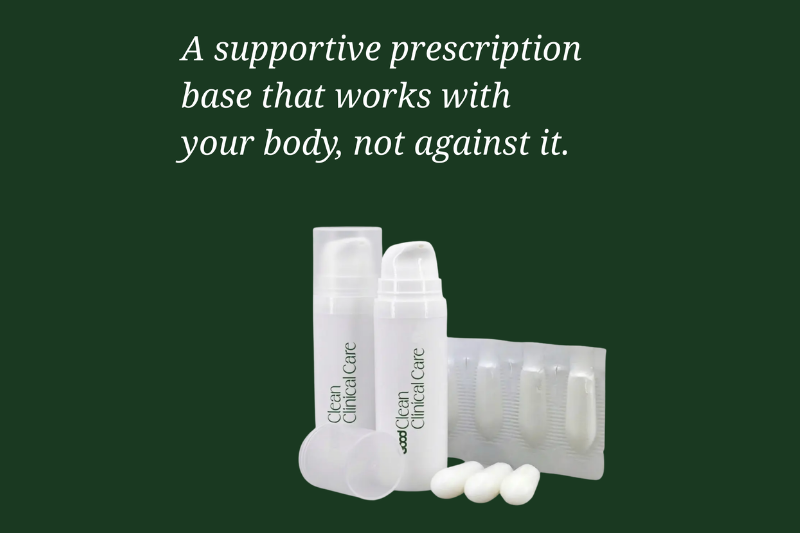
Women come to the platform and choose the symptom category that fits them, like cancer survivor symptoms, menopause symptoms, chronic bacterial vaginosis, whatever it is. They are walked through a selection process based on severity, location, and what they are experiencing. Then a licensed OBGYN in their state reviews their case, asks more questions, and confirms or adjusts the recommendation. What they receive is compounded medicine delivered in our Bio-Match® base, which means the delivery mechanism is actually designed to support vaginal health rather than work against it.

For someone who has never heard of compounded medicine -- what does that mean, and why does it matter?
Compounded medicine is medication prepared by a licensed compounding pharmacy, under the direction of a healthcare provider, to meet a specific patient's needs. Unlike mass-produced commercial drugs, which come in one fixed strength and one fixed formulation for everyone, compounded therapies can be tailored: the active ingredient used, the strength, the route of delivery, or the base that ingredient is delivered in.
Compounding pharmacies have existed for decades and operate all over the country, filling the gap between what's commercially available off-the-shelf and what an individual patient actually needs. But one important distinction is that compounding pharmacies can't create an exact copy of a patented drug. What they can do is offer the same active ingredient at a different concentration, or in a different delivery base.
That's where we come in. We formulate the base those active ingredients are delivered in. BiomeNourish™ is our base built using our patented Bio-Match® technology, which is the first prescription base designed with the vaginal microbiome in mind. Here's what that looks like in practice: Prasterone is a commonly prescribed, often expensive vaginal health treatment. It's simply DHEA at a 6% concentration, delivered in a standard base. We offer that same active ingredient at 7.5%, delivered in our BiomeNourish™ base instead.
Same standard of care. Just done better.

You mentioned that women going through cancer treatment are often put into chemical menopause, and that vaginal symptoms are actually the number one reason women stop following their cancer protocols. Most people have no idea that is happening.
It's really stunning when you think about it. Many cancers in women are estrogen-driven, so they are given aromatase inhibitors that completely shut off estrogen production -- like flipping a switch. If you are in your 30s and that happens, you are in the prime of your hormonal life, and it is gone abruptly. Women going through natural menopause experience a gradual drop. This is a cliff.
Many of them are required to stay on those drugs for five years after treatment. That is why so many drop out. Because when estrogen disappears completely, the vaginal microbiome is devastated. You get acute dryness. Over time that can morph into vulvar dermatological conditions. In the most severe cases, especially with pelvic radiation, the vaginal walls can actually adhere to each other and cannot be treated surgically. That is not a small statistic.
My chief science officer went to a conference recently with an organization called the Breasties, which has 75,000 cancer survivor members. She was giving free consultations about vaginal health and they had to switch from one-on-ones to groups because the line was around the block. These women had never heard the words vaginal microbiome. Nobody had ever talked to them about this part of their recovery.
Beyond cancer recovery, the platform addresses chronic infections, vulvodynia, vestibulodynia, and vulvar conditions like lichen sclerosus. These affect millions of women and most of them go years without real answers. What do you want those women to know?
That it doesn't have to be this way.
What I have come to understand from the brilliant scientists I get to work with is that conditions like lichen sclerosus are not that different from what happens with eczema -- a chronic inflammatory skin condition where touching the skin becomes unbearable. When that happens in vulvar tissue, it is traumatic in the most literal sense. And yet most average doctors' offices would not offer the treatments we have on this platform.
I just feel proud that women with a lot of different issues are going to be able to find something to help themselves. Many of them have seen several doctors. Many of them have been told nothing is wrong. You don't have to feel like this forever. Things can change. Your body can change.
Postpartum changes, perimenopause, menopause, cancer treatment, chronic infections -- your work touches women at so many different moments of life. What is the common thread you see?
So many women walk around feeling like there is something personally wrong with them. And it is not them. It is physiology and all the things we do not understand about it have not been taught.
The most powerful thing we do, honestly, is normalize their concerns. Normalize that part of their body. When a woman starts to integrate and understand what is happening to her vaginally and why, and she sees a point of intervention, the relief is enormous. That never stops being meaningful.
And I want to say this: we have not even talked about sexual pleasure. About the fact that we have more nerve endings there than anywhere else in human anatomy. More capacity for pleasure and intensity of experience that resets your spiritual, physical, and emotional wellbeing. So many women cannot even get near those ideas because they are in pain all the time. You have to unwind one layer first. You get the pain handled, and then people are ready to do the work of the next layer. I always feel like I'm doing the goddess's work when I do this. It's where we deliver life from. And yet so many women don't have access to that part of who they are. I think that's one of the great tragedies, honestly. I think the whole world would be different if people had healthy sex lives. That's what brought me to this in the first place.
You started this in your kitchen trying to save your marriage and your own body. More than twenty years later you are launching a platform that could change the standard of care for millions of women. What does that arc feel like from the inside?
I used to say that Good Clean Love was like having my fifth child. And I lost a child in 2018 -- my second born, when he was 26. So it's... you know, this is the work I was born to do. I feel so fortunate to wake up every day motivated by work that feels of service and brings real value to people's lives.
This platform has been the hardest thing I have ever birthed. It has taken a lot out of me. There were many times I thought, what am I doing, I should quit. But I can't quit things. That might be the one real gift I have as a founder. I am committed to the work no matter how painful or hard it gets.
How lucky am I to do the work of the goddess and help people I will never meet, and hopefully change the trajectory of millions of women's lives. That is the greatest blessing in the world.
If a woman is reading this and recognizing herself in something you have described, whether it is postpartum discomfort, perimenopausal changes, a chronic infection that will not resolve, or something she has never had a name for, what is the best first step?
Come and see how we might help you. We have a lot of education on vaginal health and we work hard to debunk the myths, because I feel like so many women have never been educated about how to deal with this part of their body. Start there. Let yourself believe that you don't have to feel like this forever. Something else is available to you.
And then look at the test. Our vaginal microbiome test with 56 targets is a really powerful place to start, because it gives you real data about what is actually happening, which means you can have a very different conversation with your healthcare provider than most women have ever been able to have.
Ready to take your test?
Get real answers with Good Clean Clinical Care's vaginal microbiome test, a 56-target qPCR panel that shows you what's actually going on
From there, you're matched with a licensed doctor (available in every state) who specializes in complex conditions like post-cancer recovery, chronic BV and yeast infections, vulvodynia, vestibulodynia, and lichen sclerosus
If treatment is needed, compounded medicine is delivered right to your door. Use code MAMAHOOD for a discount on your order.
Take Your Vaginal Microbiome Test →
Shop Good Clean Love products to support your vaginal health day to day.
Connect with Wendy Strgar on Facebook, Instagram, TikTok or YouTube.
You can also find her on The M List, The Mamahood's searchable database of mom-recommended resources, or connect and collaborate with Wendy inside of The Club membership for women Founders.